

Invoay vs Zenoti: Salon Software Comparison for Growing & Multi-Location Salons
Invoay vs Zenoti: Which Salon Software Is Right for Multi-Location & Enterprise Salon Businesses?
Choosing salon management software becomes much more important when your business grows beyond a single location.
A standalone salon may be able to operate with basic billing, appointments and customer records. But when a salon business expands to 5, 10, 50 or 100+ locations, the technology requirement changes completely.
Management needs centralized control over sales, appointments, customers, memberships, packages, inventory, employees, incentives, discounts, marketing and business performance.
At the same time, modern salon businesses increasingly need WhatsApp customer engagement, automation, AI-powered insights and integration with enterprise systems.
This is why businesses evaluating enterprise salon software often compare established global platforms such as Zenoti with platforms such as Invoay.
Both platforms are designed to solve important salon-management problems, but their positioning, technology ecosystem, implementation approach and cost structure can be different.
In this detailed comparison, we look at Invoay vs Zenoti across the areas that matter most to growing salon chains.
What Is Zenoti?
Zenoti is an established cloud-based software platform for salons, spas, medspas and other beauty and wellness businesses.
Its platform covers several major business functions including appointment management, online booking, POS, customer management, memberships, inventory, employee management, marketing and reporting.
Zenoti also provides functionality for businesses operating across multiple locations, making it relevant to large salon and wellness organizations.
Its global footprint and extensive beauty and wellness feature set make Zenoti one of the platforms that larger salon businesses may evaluate when selecting management software.
What Is Invoay?
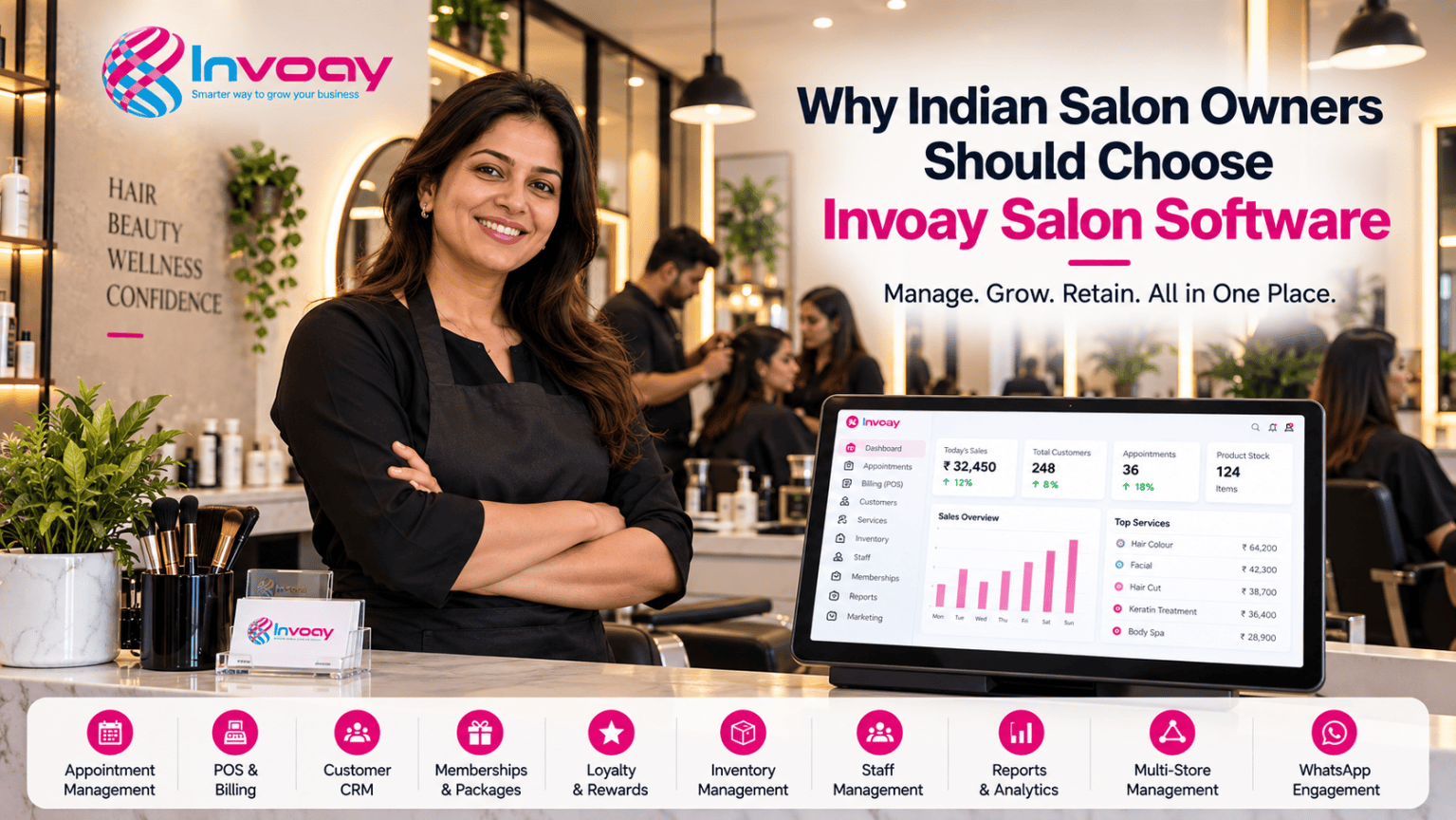
Invoay is an integrated POS, CRM, salon management and business operations platform built for standalone salons, growing salon chains and large multi-location businesses.
The objective of Invoay is not simply to replace a billing system.
It connects the important parts of salon operations including:
- Salon POS & Billing
- Appointment Management
- Customer CRM
- Memberships
- Packages
- Wallet & Prepaid Plans
- Loyalty & Rewards
- Inventory Management
- Purchase Management
- Warehouse Operations
- Employee Management
- Attendance
- Staff Incentives
- Customer Feedback
- Multi-Location Management
- Franchise Management
- Owner-Level Reporting
- Business Analytics
- Lead Management
- Customer Engagement
Invoay can also become part of a larger enterprise technology architecture through integration requirements involving platforms such as SAP, Microsoft Dynamics, Oracle and other business systems.
For customer engagement, the ecosystem can be extended with Wabixo – WhatsApp Business API and automation platform.
This creates a connected architecture:
Salon POS → CRM → Operations → Analytics → WhatsApp → AI → Enterprise Systems
Invoay vs Zenoti: Quick Comparison
| Area | Invoay | Zenoti |
|---|---|---|
| Core Market | India-focused salon, wellness and retail businesses, including multi-location enterprises | Global beauty, wellness, spa and medspa businesses |
| POS & Billing | Yes | Yes |
| Appointments | Yes | Yes |
| CRM | Integrated customer CRM | Integrated guest management |
| Memberships & Packages | Yes | Yes |
| Inventory | Inventory, purchase and warehouse capabilities | Inventory management capabilities |
| Multi-Location | Designed for standalone to large chains | Strong multi-location capabilities |
| WhatsApp Ecosystem | Wabixo WhatsApp Business API & automation ecosystem | Messaging and marketing capabilities; businesses should confirm region-specific WhatsApp requirements |
| AI | AI-led automation, customer engagement and business intelligence roadmap | AI capabilities across multiple areas of its platform |
| Enterprise Integration | Integration possibilities with SAP, Microsoft Dynamics, Oracle and other systems | Enterprise integrations and APIs available depending on requirements |
| India-Specific Operations | Strong focus on Indian business workflows | Global platform operating across multiple markets |
| Cost Approach | Designed to provide enterprise capabilities with a cost structure suited to Indian businesses | Pricing depends on business requirements, locations, modules and commercial proposal |
Feature availability, integrations, commercial terms and implementation scope can vary by plan and business requirements. Businesses should verify current proposals from both providers before making a purchase decision.
1. POS & Billing: More Than Generating an Invoice
Salon POS software is often treated as a billing application.
For a growing salon chain, that is no longer enough.
The POS is where several important pieces of business information come together:
- Customer
- Service
- Product
- Employee
- Discount
- Membership
- Package
- Payment
- Tax
- Location
When this information is properly connected, management can start answering more valuable questions.
For example:
- Which services generate the highest revenue?
- Which services generate better margins?
- Which locations are growing?
- Which locations are declining?
- What is the average bill value?
- How much discount is being offered?
- Which employees generate more revenue?
- Which products are actually selling?
- How much revenue comes from repeat customers?
Both Invoay and Zenoti provide POS capabilities.
For Indian salon businesses, however, evaluating the complete operational workflow around billing, taxation, payment reconciliation and management reporting is important.
2. Multi-Location Salon Management
This is where the requirements of a 50-location salon chain become completely different from those of a single salon.
Imagine operating 50 salons.
Without centralized software, management may have to depend on individual managers to report:
- Daily revenue
- Cash collection
- Discounts
- Inventory
- Staff attendance
- Membership sales
- Customer complaints
- Product consumption
That creates operational dependency and makes decision-making slower.
A multi-location salon platform should give head office centralized visibility while still allowing individual locations to operate efficiently.
Zenoti has established multi-location capabilities and is used by multi-location beauty and wellness businesses.
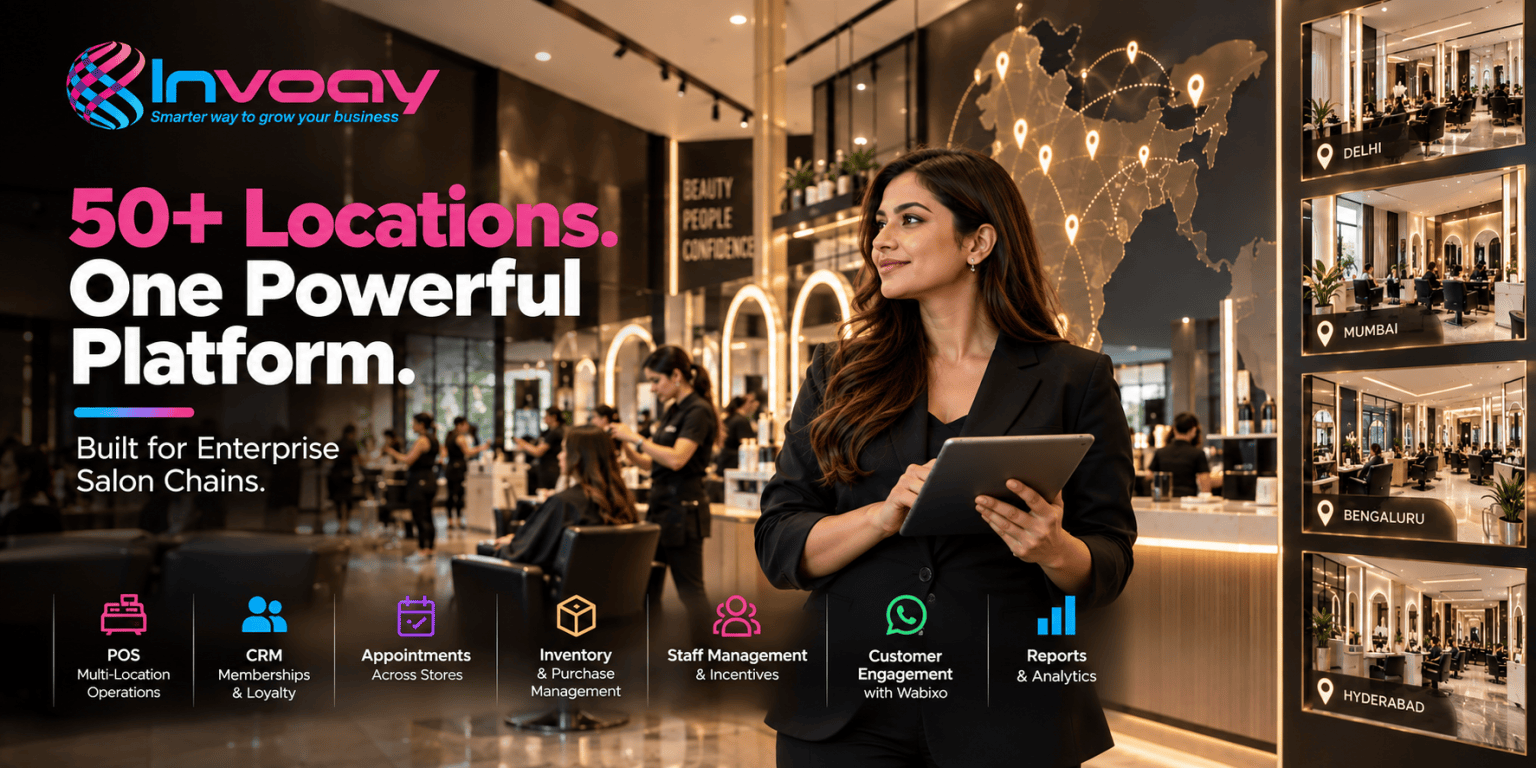
Invoay is also designed for businesses ranging from standalone locations to large salon chains.
For an enterprise salon group, Invoay can be structured around:
- Head-office control
- Location-wise operations
- Centralized reporting
- Franchise management
- Location-level performance
- Central customer information
- Inventory and purchasing
- Employee management
- Central promotions and memberships
The objective is simple:
Management should be able to understand the business without calling every store manager.
3. CRM: Your Customer Database Should Generate Business
One of the most valuable assets of a salon chain is its customer database.
Consider a salon brand with 100,000 customer records.
Those customers are not all the same.
They may include:
- First-time customers
- Regular customers
- High-spending customers
- Inactive customers
- Membership customers
- Package customers
- Product buyers
- Customers who have not returned
- Customers due for another service
Sending the same offer to all of them is not an effective CRM strategy.
The better approach is to use customer data intelligently.
Example: Hair Colour Customer
If a customer regularly books hair colour services, the salon can identify an expected service cycle and communicate at a relevant time.
Example: Inactive Customer
If a customer has not visited for several months, the business can run a re-engagement campaign.
Example: High-Value Customer
A high-value customer can receive more personalized communication instead of generic mass promotions.
This is where CRM becomes a revenue tool rather than simply a database.
4. WhatsApp: A Major Consideration for Indian Salons
For many Indian businesses, customer communication increasingly happens through WhatsApp.
This is why Invoay’s ecosystem with Wabixo can become particularly relevant.
Wabixo is designed around WhatsApp Business API communication, automation and customer engagement.
Depending on configuration, businesses can build communication workflows around:
- Appointment reminders
- Booking communication
- Membership communication
- Package communication
- Feedback
- Customer re-engagement
- Promotional campaigns
- Lead follow-ups
- Customer segmentation
- Automated journeys
Why Does POS + WhatsApp Matter?
A WhatsApp platform without business data knows very little about the customer.
A POS without a strong engagement channel knows what the customer did, but may not effectively bring that customer back.
Connecting the two changes the equation.
Transaction Data + Customer Data + WhatsApp Engagement = More Relevant Customer Communication
This is an important part of Invoay’s broader product direction.
5. AI: Moving from Reports to Decisions
Artificial intelligence is becoming increasingly important in salon technology.
But simply adding an AI label to software does not automatically create business value.
The important question for a salon owner is:
What can AI actually help me do?
Zenoti has been investing in AI across different parts of its platform.
Invoay’s AI direction is focused on connecting AI with practical business data, customer engagement and automation.
The opportunity is to help businesses move from:
Data → Insight → Recommendation → Action
AI for Customer Retention
Instead of manually searching through thousands of customer records, AI can help identify customer segments that may require attention.
For example:
- Customers whose visit frequency is declining
- Customers likely to be due for another service
- Customers whose memberships may need attention
- Customers who have stopped visiting
AI for Marketing
Marketing should not always begin with:
“What offer should we send today?”
A better approach is:
“Which customer segment needs attention today, and what communication is relevant to them?”
AI can help make that decision more data-driven.
AI for Business Insights
Large salon businesses generate a huge amount of operational information.
AI can potentially help management identify patterns that are difficult to notice manually.
For example:
- Declining location performance
- Unusual discounting
- Low staff utilization
- Changes in average ticket size
- Customer retention patterns
- Product performance
- Campaign opportunities
AI + WhatsApp Automation
The combination becomes even more interesting when intelligence is connected to communication.
Instead of simply producing another dashboard, an intelligent system can help identify an opportunity and then enable the business to act on it through WhatsApp workflows.
This is the direction in which Invoay and Wabixo are evolving.
6. Staff Utilization & Performance
Staff cost is one of the biggest expenses in a salon business.
Therefore, simply knowing employee attendance is not enough.
Management should understand:
- How many hours was the employee available?
- How many productive hours were utilized?
- How many customers did the employee serve?
- What service revenue was generated?
- What product revenue was generated?
- What was the average bill value?
- How many memberships were sold?
- How much incentive was generated?
For a salon chain, staff utilization can have a direct impact on profitability.
Invoay combines employee management, attendance, performance and incentive-related workflows so management can look beyond basic attendance.
7. Memberships, Packages, Wallets & Loyalty
Salon businesses should not depend only on customers deciding independently when to return.
Memberships and packages can help build repeat business.
Both Invoay and Zenoti support membership and package-oriented salon workflows.
Invoay additionally supports business models involving:
- Memberships
- Packages
- Wallets
- Prepaid programs
- Loyalty
- Rewards
For multi-location businesses, the rules governing where benefits can be purchased and redeemed should be carefully configured according to the brand’s operating model.
8. Inventory, Purchase & Product Consumption
Revenue is only one side of salon profitability.
Product consumption is another.
A salon can show strong sales while losing margin through poor inventory control.
Management should understand:
- What products were purchased?
- What products were sold?
- What products were consumed in services?
- What stock is available?
- Where is the stock located?
- What needs to be reordered?
- Are there unusual consumption patterns?
This becomes significantly more complex across multiple locations.
Invoay provides inventory and purchase management capabilities and can support warehouse-oriented requirements for larger operations.
Zenoti also provides inventory-management functionality for salon and wellness businesses.
9. Enterprise ERP Integration
A large salon chain may already have an enterprise technology stack.
For example, the organization may use:
- SAP
- Microsoft Dynamics
- Oracle
- Tally
- Busy
- Other accounting or ERP platforms
In such cases, replacing the entire enterprise backend may neither be necessary nor desirable.
The salon management platform may instead need to operate as the customer-facing and store-operations layer while exchanging relevant information with the enterprise backend.
A possible architecture can look like this:
Customer → Salon → Invoay POS → Central Operations → ERP / Accounting
At the same time:
Customer → CRM → Wabixo → WhatsApp Engagement
This architecture can be especially relevant for enterprise businesses that want centralized ERP governance while maintaining a specialized salon operating system at store level.
Integration scope always depends on the systems, APIs, data flows and business requirements involved, so enterprise integrations should be evaluated during solution design.
10. Reporting: Don’t Just Ask “What Were Today’s Sales?”
A modern salon owner should be asking much deeper questions.
For example:
- Which location has the highest growth?
- Which location is losing repeat customers?
- Which staff member has the highest utilization?
- Which service generates better revenue?
- Which products are moving slowly?
- How much discount is being given?
- What percentage of customers return?
- Which memberships are performing?
- Which campaigns bring customers back?
Both Invoay and Zenoti provide reporting capabilities.
For larger businesses, the more important question is whether reports can be translated into management decisions.
11. Cost: One of the Biggest Factors for Indian Salon Chains
Cost becomes extremely important when software is deployed across many locations.
A difference that appears manageable for one outlet can become substantial when multiplied across 20, 50 or 100 locations.
However, businesses should not compare only the headline subscription fee.
They should calculate the Total Cost of Ownership (TCO).
What Should Be Included in Salon Software TCO?
<
ul>